
8 lessons from a serial entrepreneur
Luke Brynley-Jones was an early pioneer in the social web and creating on-line communities. He has started several businesses, lost a business, flipped a business, made some money and lost some money.
He now runs OST The Social and Digital Agency
Lesson 1 - Nobody is indispensable.
If there is someone in your business who thinks they are, and gets too greedy, get rid of them.
This is what propelled Luke into leaving employment and starting his own business!
Lesson 2 - Don't take on other people's responsibilities.
With a friend who worked with Sir Tim Berners-Lee in the late 1990's, Luke started a consultancy business for companies who were investigating the new idea of connecting with customers on-line. British Airways, Christian Aid, Thomas Cooke, YMCA were among their first clients.
As is common with many small businesses they struggled to get paid by their much bigger corporate clients so decide to stop being consultants and instead create their own social network platform called eTribes.com.
Lesson 3 - Nobody owns and idea. It's all about the implementation.
With eTribes, they raised £3 million and hired 70 developers. The site allowed people to blog, share music, photos and videos, book events, store documents and make phone calls and attracted 50,000 users.
With too many ideas and not enough implementation, eTribes eventually went bust.
Lesson 4 - A great business requires a team of friends and equals.
Luke joined Doug Richards in a business pioneering integrated mobile messaging. Investors pulled the plug in 2008 during the recession but Luke had the opportunity to work with a great team of people.
He uses the lessons learned then in building a strong team at OST Marketing.
Lesson 5 - The right price is whatever people will pay.
Luke spent a year touring with School for Start Ups with Doug Richardson and from this learned a lot about running a business, especially about pricing. He also had the opportunity to research the best of the best in the social media world and used this experience to build Our Social Times and run international conferences featuring cutting edge ideas and good practice in the social media world.
Lesson 6 - To survive the digital age, businesses need to evolve.
The conference business started to wane and at the same time, Luke had clients knocking at his door asking for help to use social media. He decided to kill off the conference business and start OST Marketing, concentrating on the B2B tech market.
Lesson 7 -Most marketers are too busy to act strategically.
The reason that the current business is doing so well is that most marketing departments are harried, pressed and under-resourced. OST Marketing has developed a blueprint and case studies that show that what they do really works.
Lesson 8 - Results are often less important than relationships.
OST Marketing lost a very big client despite delivering great results because another agency stepped in and built a relationship instead of relying on the numbers to prove their worth.
Final lesson - keep learning more lessons!
Luke Brynley-Jones
www.ostmarketing.com
@lbrynleyjones
@ostmarketing

How Not to Fail in Business
Ask the Expert” Q&A with Ann Hawkins
This is a compilation of the live Q&A
Q. What do you think is the main reason that new businesses fail?
Ann Hawkins Government statistics show that 50% of new businesses fail within 12 months, with 90% no longer trading after five years. 10% close involuntarily due to insolvency and 90% cease trading because the business is not providing a satisfactory income for the owners, so lack of profit is the overwhelming reason for failure.
The question I get asked most by business owners is how to manage their time so that they're not working 24/7 - this is usually related to not making enough profit to pay for help. Too many business owners are barely scraping by, despite working really hard, and it's often just because no-body has shown them them how to run a business profitably.
Don't run out of money!
Ann Hawkins The simplest way to deal with the risk is to have another income stream while you build up your main business. Running out of money is the biggest threat to any business and keeping a check on cash flow is the most important activity for a business owner. Is there something you can create once and sell many times, e.g. an ebook or course? Preferably this would be an easy entry into your higher priced services too.
Andy Boothman What do you need to think about when going into business with someone?
Ann Hawkins All the obvious things about trust, being really clear about expectations, writing EVERYTHING down, getting a proper agreement but also looking at some unexpected things. A lot of things are covered in this post (and talk to me if you need help!): "Starting a business with friends? You need this!"
Planning is vital
Q. I take it you don't do new year's resolutions, but can I ask, how far in advance do you plan your goals for each year and what sort of strategies do you use for goal planning?
Ann Hawkins I think it’s important to have a life plan - when do you plan to retire, how much money will you need as a pension, what will you do when you retire - then plan back from there. The shorter term goals should all lead towards the big one and help you to make decisions. Of course stuff happens that we don't plan for but not having a plan means just taking each day as it comes!
Q. Yes, makes sense. In other words, a plan of some sort is better than no plan at all?
Ann Hawkins Yes, then all the smaller goals, like staying fit, eating well, learning new skills have a real purpose. The biggest benefit tho, is that it makes it easier to make decisions on a day to day basis.
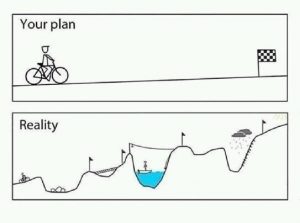
Q. I guess it's a bit like having a map - you figure out where you want to go then you can look at route options and if you come across a road closure then you divert and find an alternative route.
Ann Hawkins There's a great phrase "The map is not the territory" that explains that although we know where we want to get to, we don't know how difficult or easy the terrain will be until we set out, but as long as you know where you want to end up, and you want it enough, you’ll find a way to get there.
Marketing and social media
Q. Is a Facebook fan page really needed for leads opportunities for new business? Sometimes I feel like quitting all the social media but then I ask myself how it will affect my business in the social media and technology age.
Ann Hawkins That's a really BIG question. Short answer, don't quit. On-line presence is really important but a Facebook Page is notoriously difficult for a small business and its much better to have your own mailing list.
Before anyone dives into using social media I’d advise you step back and think: How many clients do you need a month? How much is each one worth (revenue to your business). Do you get repeat business from old clients? If the number you need is low there may be better ways than social media to find them but you still need an on-line presence for validation. It's always worth remembering that most things in business have already been done by somebody so it's always worth looking at what the successful people in your sector do
The future of business
Q. What do you think the business world will look like in 10 years time?
Ann Hawkins I get very excited about technology which is all about change but I’m equally fascinated at the enduring predictability of how human beings relate to each other. I think businesses of the future will continue to be heavily reliant on the internet and devices will talk to each more but humans will always need personal interaction, community, transparency and trust in each other.
Business owners need to understand how technology works without becoming a slave to it (turn your notifications OFF and CHOOSE when to respond to them!) but they also need to know how human beings work. However much technology can help us, we’ll always be selling to human beings and our ability to build trusted relationships will always and forever be the most important part of business as well as life.
Our biggest challenges in society will be to provide alternative purpose and meaning to people whose roles are taken over by artificial intelligence, to drastically reform education and to care for an ageing population - these are all business opportunities!
If you've got more questions for Ann on "How not to fail in business" ask in the comments section below, check out her blog Inspiring Entrepreneurs or follow her on Twitter @AnnHawkins for more great tips.
How to build your confidence
Ask the Expert Q&A with David Brown Potentiality Coaching in the hot seat!
This is a compilation of the live Q&A.
Self belief
Kathy Salaman What would you say are the best ways of helping someone to improve their self-confidence? (huge question, I know.)
David Brown Well yes, it is huge. Very generally though I would say listen to your heart rather than the learned messages from society (family, fends, peers and the media) that you are not good enough and that you need to be more, do more and want more. What does your heart say?
In doing what other people expect of you, you are rarely in a position to ask the question, what do I want for myself. Self affirmation is the key to confidence. If you are pleased with you, you are more than half way there. Seeking approval from others is only a temporary solution. Find the solution within by finding your authenticity, values and purpose.
Q: If someone is stuck in the belief that they're not good enough how do they break out of that? Do they need evidence to disprove what they've been told - maybe all their lives?
David Brown I think evidence is really important. In fact we have all the evidence we need. Usually it is a question of mind-set. We see events through the lens of I am not good enough, when in fact shifting that mind-set can show you that you are. I used to believe that I was not good enough to host an ask the expert session. I look at what makes we qualified to host such an event. What am I expert in. We are all experts in our selves, our journey and our experience of that journey. In being your self you are good enough. In measuring up to others, you are always lacking in some regard. Accepting you for who and what you are is really important in this. It is the start of think "I am OK" and you build from there.
The Mind / Body link
Ann Hawkins How does the mind / body link work David? Does one come before the other?
David Brown It is a chicken and the egg thing I think. Let's start with the mind. Thoughts in the mind show in the body. Posture, how you walk, stand and sit all show your thinking to some degree. Thoughts such as stress and anxiety can show up in the body as tension, stiffness and can progress to illness and ultimately dis- ease (and sometimes quite severe) if left too long. It is important to address these thoughts for the impact they have on the body as well as the way they affect the mind. Tension in the mind means tension in the body. You can create relaxation in the mind by addressing these thoughts and also by relaxing the body. Stretching, exercise, diet, hydration, meditation and mindfulness all relax the body and so the mind too.
David Brown Always step out of your comfort zone. All confidence work stems from that in my experience. Remain in your comfort zone and your body will not respond with growth. Step just outside and your body is basically being told.... step up. We need more muscle, strength, stamina, balance, coordination. Consistently step out of your comfort zone and your body will respond. It is designed to do so. If you step too far out, it usually results in overwhelm. For the body it is injury, pain, tightness etc. Apply this to the mind, it manifests as stress, anxiety, depression, avoidance, denial etc. As you might expect, the two go hand in hand. Some stress is good- in mind and body it leads to growth and greater confidence. Too much stress, i.e. overwhelm, it leads to a contraction and an eroding of confidence.
Andrew Hawkins what about rehabilitation after injury or accident? Apart from specifically targeted exercises what would be a good general regime to recover full mobility and confidence in movement?
David Brown Always step out of your comfort zone. All confidence work stems from that in my experience. Remain in your comfort zone and your body will not respond with growth. Step just outside and your body is basically being told.... step up. We need more muscle, strength, stamina, balance, coordination. Consistently step out of your comfort zone and your body will respond. It is designed to do so. If you step too far out, it usually results in overwhelm. For the body it is injury, pain, tightness etc. Apply this to the mind, it manifests as stress, anxiety, depression, avoidance, denial etc. As you might expect, the two go hand in hand. Some stress is good- in mind and body it leads to growth and greater confidence. Too much stress, i.e. overwhelm, it leads to a contraction and an eroding of confidence.
Ann Hawkins Can people ever successfully work on this on their own David? It sounds as though its a very delicate balance that needs someone with skill and experience as a guide.
David Brown I think there are skills and mind- sets you can develop to allow you to tackle these challenges on your own. A good guide should empower you to stand on your own two feet. Often we are too close to our "stuff" to realise what we are doing to undermine our own self- confidence. A guide can point that out so that we become more mindful of our own self sabotaging behaviours. Once we develop the skills to notice them we are self reliant and able to walk the journey alone again.
Overcoming fear
"Ttoo many of us are not living our dreams because we're living our fears". How would you suggest people approach fear in business/personal life?
I always love the FEAR acronym:
False
Evidence
Appearing
Real
We manifest what we focus on. If we focus on fear, we get fear. If we focus on our dreams consistently and take positive steps to manifest them, then they will happen. Fear is a contracting force. It's opposite, perhaps confidence, is an expanding force. Focus on your dreams realistically and take the steps out of your comfort zone to grow your confidence and your business. Fear keeps you locked inside your comfort zone and so you and your business or career do not grow. When you are self employed, your growth is your business's growth. When you are in employment, substitute business for career.
Further reading
David Brown Thank you for your questions. The mind is a powerful tool which when left unchecked can powerfully undermine you. Only through mindfulness and awareness can we begin to pull it back from its habitual wondering, comparing and sabotaging and use it instead to empower, nurture and create a life of beauty. Your FEAR acronym is so true... we create our reality. It is your choice and it takes work either way. There are loads of blogs on my website www.potentialitycoaching.co.uk that go into the topics we have covered here in more detail.
Happy reading and I hope it helps.
If you've got any questions for David, ask them in the comments section below ...
How to make better decisions
Making good decisions is an essential skill in business, and in life.
Henry Ford attributed his success in building The Ford Motor Company to his ability to make good decisions swiftly.
Andrew Hatcher, a lecturer at The Judge Business School in Cambridge, has researched and studied the decision making process and shared the basics of how we can learn to make better decision and, crucially, how not get paralysed by procrastination.
These are the main points that Andrew covered:
We make about 170 medium sized decisions every day.
Every decision is a battle between rational factors and emotions.
Sub consciously we may give one factor more weight than the other because of pre-set biases.
What is the benefit of the decision?
Building a plane in 48 hours - logic says it won't be safe, won't be of much use but the benefit is the emotional impact of proving that the workforce can be productive and to raise morale.
The value of forecasting the result of the decision is not necessarily in the accuracy of whether it is a good decision but of whether the decision is publicly acceptable.
There's no point in looking backwards on your previous decisions.
You can't evaluate a decision based on information you didn't have at the time you made it.
Worrying about an outcome you can't predict can put you into paralysis. There is always an element of luck.
Planning for decision making:
You can't make the decision until you've done some research
Small impact / big impact
Short term / long term
Your money / someone else's money

Only do as much research as you need to come up with a decision (In dating make a decision from the first 37 people. No point in going on to research 100)
Pros and Cons
The easiest and therefore often discounted way to make a decision, make a list of Pros and Cons.
This should only take about 3 minutes. Get somebody else to review it for bias.
Cost benefit analysis
How much will it cost to implement the decision, what is the value of the benefits?
Tangible costs / Intangible benefits. Whenever you see an intangible benefit try and evaluate it. Better to put a value on it than ignore it.
Ford Pinto - used to catch fire. Cost $11 to upgrade each car = $137 million. Nominal costs of deaths to society $45million.
Ford used this information to decide not to upgrade the cars.
The result was $125 million in punitive damages, reputation damage etc. Rational decision was not the right one.
What is the cost of doing the calculation?
Don't spend days and weeks on the calculation if the impact of the decision doesn't warrant it. Keep it in proportion.
When do you decide to give up?
Would you leave a movie half way through if you didn't like it, or stick it out?
Would you finish a bottle of expensive wine even though you don't like it, or throw it away?
If you had to decide to give up one project out of three, how much would you consider the time and money you'd already invested?
This can sometimes be skewed by the amount of time or money already invested instead of looking at the consequences of investing more.
Try and forget about what has already happened (the investment of time and money) and look at the benefits you will get (or not) by continuing.
Make sure you are doing the highest value work.
Work out the opportunity cost.
"By doing bookkeeping I'm losing the opportunity to do something else that is (potentially) of higher value."
The fewer choices we have, generally, the more committed we are to the decision that we make.
Emotional decisions tend to be fast, based on experience, self evident and highly context specific.
Rational decisions tend to be slow, logical, not context specific.
If you are struggling with making a decision, stop and do something else, preferably sleep on it. When you come back to it, the subconscious mind will help to balance things up and make it easier.
Re-evaluate decisions you make on a regular basis, e.g going to the same business exhibition every year.
Share your thoughts on Andrews talk, or your experiences and questions on decision making in the comments below.
How to attract a business investor

Ever wondered what it takes to get someone interested in investing in your business?
Peter Cowley was UK Business Angel of the Year 2014/15, is a charity chair and trustee, mentor and non-executive director.
Peter’s talk at Drive Cambridge was, in the words of one of the delegates, “... the whole story, warts and all. Fascinating and unflinching in his delivery, we all left the meeting wiser and energised. The banks are now in the back seat and private equity is in the front and available. But you have to have the right idea and, most importantly, you have to be the right person for Angels to invest.”
Win some, lose some
Peter started by putting things in perspective and illustrating that investing is an educated gamble. Of the businesses he invested in recently, he has had 4 positive exits, 5 failures and 5 are terminally ill, so likely to fail soon.
Of over 1,000 positive leads he gets annually, only 30 are likely to survive the due diligence process and of those, only 10 will go on to a completed deal.
The ideal team size of founders for Peter is two or three.
What could go wrong?
In the US, of all tech businesses founded in 2000, only 20% were still in existence in 2009.
The top five reasons for failure include:
No market need 42%
Ran out of cash 29%
Not the right team 23%
Outcompeted 19%
Poor product 17%
It’s not just about the money
It was obvious that Peter likes to invest in businesses where his experience and expertise can add real value and where he can form an enjoyable working relationship with the founders.
Angels typically invest £40k - £60k a year and get between 25% - 30% return.
Of the people Peter invests in, the average age is nearly 40.
1/3 were born overseas and 43% are repeat entrepreneurs.
A previous failure is not an obstacle to future success.
A typical deal timescale is 3 - 6 months.
The business plan is crucial
Many plans that Peter sees are ludicrous, many are untrue and many wildly optimistic.
The numbers Peter looks for in every business are, “How much does it cost to acquire a new customer?” In B2C business this can be £40. In B2B it can £20,000 per customer.
The next one is, “What is the profit over the lifetime of each customer?”
Too many businesses don’t work this out properly and end up running out of money because the business can’t be run at a profit.
Lessons learned
Don’t back founders who are in a personal relationship - a couple is more like one person than two.
Build up trust and knowledge of founders before investing.
Have the difficult conversations as early as possible.
Choose co-investors with care.
Have an open, trusting relationship with founders.
It’s easier to get divorced than sell illiquid shares!
These are some of the comments sent to us after the event:
From Jeremy Harrall PhD RIBA:
Thank you for Friday’s event, I enjoyed it so much so I felt compelled to contribute a few words.
The profession of entrepreneurship, is not to be confused with the fashionable yet trite references used to describe the well trodden and relatively safe business activities of most people. Peter Cowley is a professional entrepreneur, one of a handful in the UK that can lay claim to a full-time career in this arena.
As a front row attendee, I witnessed close-up the innate passion and confidence that underpins Peter's no-nonsense approach to his chosen endeavours. It became apparent that one of his singular tenets is a self-belief that when an opportunity is identified, he can play a pivotal role in making it a reality. Few people have this ability, even fewer have the gonads to put their own money at risk.
Listening to Peter Cowley's words of wisdom will benefit any entrepreneur at any stage of their business.
From Mary Mansfield:
"It was good to learn that Angel investment is not just about money, but also about networking and working with businesses as they hatch and grow. It was also useful to be informed about the criteria that Angel investors use when they consider applications, given the fact they are bombarded with thousands of applications at any one time, which are then whittled down to 30, then just 10!
Some of the advice given was that:
- the business plan must be realistic.
- that those seeking investment are actually LISTENING to their market, suppliers etc. The investor is also listening and deciding whether they can work together with you.
- Trust – no use lying on your application.
- Do due diligence – investors need to know you are going to be honest and good to work with and will check out your network.
- Team size matters – hard for an investor to back a single founder. Although less to argue with, if there is a problem, there is no one else to turn to.
- Failure is okay, if you learn from it. Look at Silicone Valley."
From Sam Sales:
It was great to hear from Peter Cowley some very straightforward advice about growing your business. The list of why businesses fail is certainly something that should be given to all business when they start out. Peter mentioned that you should listen to your investors, it is a key skill in business, and taking advice that might not be what you want to hear could be a factor for a businesses success.
From Kelly Anstee:
Peter Cowley really is a genius, with a personality. I never imagined an Angel (Peter in this case) to be so entertaining and I was chuckling throughout - the best way to finish your working week. (I guess that's how people perceive accountants so I should be used to this mismatched alignment.) His presentation was honest from start to end. The skill sets, experience and tips he laid down were fantastic. Down to earth and completely an expert in his field - it was a pleasure to hear his story (and he Rt'd @TaxSwag too - Happy Days!)
To grow your business - get uncomfortable!
You’ve heard the expression: if you’re not growing, you’re stagnating?
If not, you have now.
In my experience this is true.
It’s true for you on a personal level and it’s true for your business.
And, if you’re self- employed, your growth is linked to your business’ growth.
If you’re not pushing yourself and your business forward in some way, then it is stagnating. Left too long and it begins to shrink. You have to be strategic about your business growth and the growth you need to do to make your business grow. However, there are potential stumbling blocks, inherent resistance we all have when it comes to growth, development and change in areas where we feel uncomfortable and challenged.
You know this resistance to change as your comfort zone.
When you feel comfortable and confident in any role, doing anything, you are operating inside your comfort zone. To reach this stage is wonderful and it is important, as you are performing well in this role and this is good for productivity, customer satisfaction and sustaining your business. The comfort zone is not a bad thing in itself, it is just not the place you are going to grow, and eventually, neither is your business. So if you want to up productivity, customer satisfaction and grow your business, you are going to want to step up, to do something new and different, and that can be a challenge.
Now you are in the realm of stepping outside your comfort zone.
There are two ways to do this- either step just outside or way beyond it. The way beyond method suits some people as they love the challenge of really pushing themselves. It’s an adrenaline rush. For others, this method leads to overwhelm. I’m in this latter category.
For years I have had a fear of public speaking and tried to beat it. I’ve tried to speak at networking events, talks, lectures and so on and never been able to do it without feeling such overwhelming anxiety it was unreal. I knew my business was suffering for it, because I couldn’t get out there to promote myself. And so, rather than follow the lead of those I took advice from and take large steps which is what I had done in the past, I worked with a life coach to find a way that worked for me. It turned out that all I needed was to take smaller, more manageable steps. So I founded a public speaking group on MeetUp and for six months I spoke to whoever was in the room about something I was passionate about. It was never more than 5 people, but trust me that was a great start! In time I realised I could manage the anxiety fine and now the largest audience I have spoken in front of is three hundred.
The reason the audience size could increase is because once you have done something, your comfort zone expands with your experience. The fact of it is, if you want to keep growing you need to keep stepping out of your comfort zone. And, if you want your business to keep growing in new and exciting directions that stimulate and excite you, you are going to have to push your self to explore those avenues. This is an individual journey, as each person has their own sense of how they are prepared to stretch themselves.
Comparing your self to others does you no favours
Go at your own pace and make sure you keep moving forward, challenging your resistance to grow your self and your business.
Are you feeling cosy in your business? Have you noticed you haven’t offered anything new for a while because there is resistance within you to change and growth? Do you find your self feeling bored with your business? If so, you may be stuck inside your comfort zone and fearful of stepping outside it. Breaking out can be challenging for many reasons.
I am offering discounted coaching sessions to DRIVE members to support you in stepping out of your comfort zone and giving you the chance to grow your business into something that keeps evolving in the way that makes you grow too.
Get in touch if you'd like to talk about how we might work together or add your name to my mailing list to get new blog posts as they're published.
www.potentialitycoaching.co.uk
How to create a recurring £200k a month income
Every business owner dreams of making money while they sleep.
The sort of product that you create once and sell many times, in an automated system, is much sought after.
How do you come up with that killer business idea?
 Rob Percival was a maths teacher who did a bit of coding on the side, building websites and dabbling in being an entrepreneur.
Over a period of eight years he created a few businesses that didn’t work (Homesexchange.org anyone?) and two businesses that between them now bring in £200,000 a month.
The two successful businesses are EcoWebHosting and Rob’s on-line training courses for Udemy, the web's biggest training platform, which have been bought by over 250,000 people.
Rob is delightfully open about everything he’s learned along the way – good and bad – and has put together these six lessons that can can be applied by anyone who is looking for that breakthrough idea:
Lesson #1. Build something people want
Seems obvious but a lot of people throw marketing money at something they think people “should” want instead of really testing an idea to see if anyone will buy it. It’s turning the usual business model on its head and asking “How many people want this?” instead of “How much money will this make?” See what Paul Graham of Y Combinator has to say about this.
Lesson #2 Automate everything
(specifics depend on the type of business)
Holy Grail: Create recurring revenue!
Use text expansion – save typing the same phrases over and over
Set up FAQs and a help section on your website to reduce queries
Allow customers to do as much as possible for themselves on your website
Outsource repeated tasks
Use IFTTT (If This Then That Workflow app)
Learn to code – even a little bit can save a lot of time! (A.H. -I learned HTML in 1990 but I’m not sure that counts!)
Lesson #3 Talk about everything, especially money
Be open and honest
Two ways to ensure success: become the best at one specific thing OR become very good (top 25%) at two or more things.
Get a mentor (Yeay! – I didn’t pay him to say this!)
Join a MasterMind Group (or this!)
Find someone who does something similar and get together to compare notes
Spend at least 2 hours a week just thinking about your business
Read Rich Dad Poor Dad and understand the difference between being self employed (you own a job) and owning a business (you own a system).
Lesson #4 Create recurring revenue and systematise your business
Transform the business so it’s not about you.
Think of ONE thing, right now, that you could systematise in your business.
Find a way for people to pay a small amount of money regularly, over a long period of time.
Choose related products so that you can sell more things to the same people. (Again, I didn’t pay Rob to say this but it’s always cheaper to sell more to existing customers than to spend time and money acquiring new ones.)
Lesson #5 Don’t rush to take on employees.
When you try to replace yourself you’ll need more people than you think. (But do it anyway).
Plans are useless but planning is indispensable.
We overestimate what we can do in a day but underestimate what we can do in a year.
Lesson #6 Begin with the end in mind
What would you do if you had £10m in the bank? What would your ideal life be like? Work towards that now.
Persist! It took Rob eight years to come up with an idea that worked.
If this talk has inspired you to make changes in your business, or you have questions about Drive events, please add them to the comments section below or get in touch to find out how you can become part of it all!
Do you make a good second impression?
It's easy to make a good first impression.
You get into the right clothes, do a bit of grooming, practice the smile and the firm handshake, learn a bit about body language and wham, bam, thank you m’am, you’ve aced the first impression.
Everyone thinks you’re a great guy or gal and relaxes.
Then what?
Then the real you gets an outing.
When you stop trying to impress is there a different you that comes out?
I’ve recently had to re-asses my opinion of someone who always gives a great first impression performance and remembered this that I heard from George Raynault, a multi-millionaire I worked with for several years who was a very wise man:
Someone at a reception smiled a hello and shook my hand warmly.
Later I saw him sneering at one of the waiters.
And, later still, talking behind someone’s back.
You only have one chance to make a first impression, true, but you have an
awful lot of time to make plenty of second impressions.
If you are meeting someone for the first time and may not get a chance to see
them again, a first impression really counts. For a very short time.
However, if you are going to be interacting with a person over a longer period of
time then second impressions are even more important.
Is someone who is rude to waiters and cab drivers or who cheats a barmaid out
of small change really someone you want to do business with?
If someone is always blaming other people and doesn’t treat others as they’d like to be treated why would you recommend them to others?
If people know they can rely on you to behave well and honorably even if no-one is watching, if you listen to them, make them feel good, cheer them up, be kind or give them good advice they will always seek you out and introduce you to others.
Second impressions are even more important than the first ones.
What can we learn from puppets?

"Puppets help us to learn about ourselves."
I asked Drive Cambridge member Jo Bryant of The Hands On Company, "What’s exciting about your business and why should anybody care about it as much as you do?"
This is what Jo said,
"Whatever our age, we use play to learn about ourselves. The Hands-On Company provides a vehicle for people to do this. We bring puppets to nursery schools, care homes and many other institutions and through different activities encourage people to play and create dramas that allow them to examine ideas and feelings that are sometimes too deeply personal to express in any other way.[pullquote] "An elderly man living with dementia suddenly started waltzing with a puppet, unaware that I was behind it doing my absolute best to keep up with his fancy footwork."[/pullquote]
Parents learn how to play with their children
One session we ran was with a group of parents who wanted ideas on how to improve the way they played with their children. There were a lot of social workers present, which made for a slightly uptight atmosphere, but the minute the puppets were unpacked the fun was irrepressible. One boy, who was was labelled a selective mute, amazed us all. He began to converse through the puppet he created with his mum. It was a truly touching moment to hear his puppet voice explain exactly what his puppet likes to do.
A member of another family group got in touch with me three years later and told me they were still using their family puppet to discuss personal changes and issues.
Making new friends
In a workshop about friendships, each child had a puppet to represent different types of friends. A nine-year-old girl called her dog puppet Meatballs. She decided he looked like a meatball and that this was his favourite food.  We had great fun building up his character and deciding that he was a true friend as he was caring, but needed lots of meatballs to keep his energy up. In the feedback for this session, the leader told me that this girl's younger brother was very ill with leukaemia and she had not been eating properly. Her parents were thrilled that she had asked for meatballs for dinner that evening and excitedly described her play with the puppet. Naming and playing with the puppet seemed to be a turning point for her.
In another session I encountered a thirteen-year-old boy who was brave enough to share a bullying incident through the voice of a large monster puppet.
Making decisions about sex and drugs
In the work we do with teenagers, they use puppets to act out dramatic scenarios and we ask them to consider these three statements:
where are you?
who are you with?
how do you feel?
The scenes they play out help them to make informed choices around sex and drug use.
 Moments like these happen whenever we interact with people - from a senior manager becoming overly attached to a hairy puppet because of shared conflicts to an elderly man living with dementia suddenly waltzing with a puppet, unaware that I was behind it doing my absolute best to keep up with his fancy footwork.
Sometimes when we run our businesses, we get bogged down in the worries of cash flow and energy dips, but it is the magical moments that help us to keep working at it. I continually feel privileged to be a part of these and I have the profound hope that there are many more to come."
Jo and her team also make puppets to sell, so if you'd like your own Meatball or have a project that puppets might help you to explore, give them a shout.
You'll also find The Hands On Company on Twitter, Facebook and YouTube.
Do you have invisible boundaries?

Instead of pushing against a barrier, what if you could just walk round it?
David Brown helps people to realise that most boundaries exist only in their minds.
The picture of a gate that has no fence attached to it symbolises the freedom we have to choose how we see things.
When I asked Drive member David what excites him most about his business, this is what he told me:
"I had a successful career in science for 15 years but always felt that something was missing. As a young man I was very shy and found that martial arts training helped me overcome my shyness and gave me confidence. It also gave me an opportunity to understand a lot about myself and to explore self-expression.
I eventually decided to change my career and use the techniques I have learned and developed from life coaching and life experience, as well as martial arts, to help people who want to develop the confidence to express themselves and to do more of what they love.
[pullquote]My job is to be playfully curious, to challenge, champion and encourage people to look inward and discover their own truth, potential and meaning. [/pullquote]I’ve learned that delving into their untapped potential leads people to greater personal, professional and life success.
There is nothing more fulfilling than seeing people realise that things don’t always have to be the same and that they have the power to change their lives, often just by looking at them in a different way."
David has co- authored a book, Nourish the Flame Within, and is involved in Our People’s Coach Flash Mobs, speed- coaching flash mobs on the city streets of the UK.
If you know people who would like to have more of what they love in their lives, a new career, engaging in a new hobby or nurturing important relationships, they can get in touch with David at Potentiality Coaching
The Drive Networking Manifesto

Our members have an inner DRIVE to be good at what they do, to be self-directed and connected.
People join our network to:
Connect and learn,
support and be supported
inspire and be inspired
to be human.
To build great relationships:
Be curious,
ask why rather than what
say, "tell me more"
find the person, not just the business.
To help and be helped:
Help people just because you can,
not because you expect anything in return
not because of karma
just because you can.
Listen more than you talk,
leave space
work on being interested, not interesting
make people comfortable
Have conversations instead of pitching,
look for connections, not leads
share your network
ask how you can help
Ask for help,
helping makes people feel good
ask them, let them,
and pay it forward with no expectation of anything in return.
Trust.
Autonomy, Mastery and Purpose
"The secret to performance and satisfaction is the deeply human need to direct our own lives, to learn and create new things, and to do better by ourselves and our world." Dan Pink
In his book "Drive", Dan Pink examines the three elements of motivation: Autonomy, Mastery and Purpose.
These are the words that struck a chord with me as I was searching for a name for this new style of networking organisation.
I've had a love / hate relationship with business networking for many years so, in the spirit of "take your own advice", the time had come to create something different.
The result is a business network that will do so much more than networking and will increase the success rate for small businesses (the majority fail before they get to five years old and of those that survive, very few make enough money for their owners to live on).
Members believe that collaboration is better than competition and get an unprecedented level of support and advice, from confidential mentoring to business training, networking opportunities, and help to join the dots between all the knowledge, expertise and skills that are available to help businesses to succeed.
If you like the idea and would like more information about what's involved in joining Drive, take a look at www.drivethenetwork.com and, wherever you are in the world, get in touch now and I'll gladly share the details.
Hope to see you involved in Drive soon!
Best wishes
Ann Hawkins