
AI is awesome - except when it isn't!
What does the acceleration of AI development mean for us?
Many of the things we've become familiar with use AI.
In 1640 Blaise Pascal invented the first digital calculating machine and some inventions that rely on "artificial intelligence" go back a lot further than this.
The explosion of new apps since Microsoft invested $10 Billion in OpenAI, maker of ChatGPT which was launched in November 2022, has both excited and dismayed the world. Some see huge opportunities and some see the destruction of jobs. Some even see the destruction of humanity.
In this Ask the Expert event, we invited Jo Stansfield to give us her views.
Jo is the founder of Inclusioneering a social enterprise specialising in diversity, equity, and inclusion (DEI) solutions and consultancy for technology and engineering organisations. Jo has been a member of ForHumanity for many years. For Humanity is a not-for-profit public charity that examines and analyses the downside risks associated with the ubiquitous advance of AI & Automation to engage in risk mitigation and ensure the optimal outcome ... for humanity.
This short video is Jo's introduction to the topic:
https://youtu.be/Fn6L4ZWYOQk
Jo shared this information about how ubiquitous AI is in our lives

In breakout rooms our members discussed how ChatGPT and many other AI apps have given them free, easy to use tools to create written content, videos, images, music, and much more.
The search formats of Bing's Chat GPT and Google's Bard have brought new dimensions and concerns to how information is accessed. This has many implications for SEO and for the huge search and advertising business (estimated at over $500 Billion) that Google has almost exclusive power over. When Samsung decided to use Bing as the default search engine on their latest mobile phone it prompted Google to accelerate the development of Bard to compete with ChatGPT.
There are also concerns about how information is being gathered and used to advance machine learning and how we can protect our original creations and both give and get credit where it's due.
The biggest concern is about accuracy and bias.
Jo's reflections on bias:
- Some are built in in the training data --- the quantity of data needed is huge. Mitigate with better training data?
- Some are in design --- limitations of what the design team consider. Mitigate with diverse teams.
- Some are introduced by the algorithms continuing to learn --- Mitigate with regular evaluation and review of performance, with means to rectify learned bias.
- Some are about self-reinforcement of bias cycle – e.g. ShotSpotter
- Some are by application not being valid for its deployed use
- Some are about access

We just scratched the surface of this hugely complex topic and are very grateful to Jo for giving us a glimpse of how things are developing so rapidly.
Find out more and get involved
- From The World Economic Forum: Here's how to make algorithms work for all of us.
- WATCH: Coded Bias (available on Netflix)

- READ: Weapons of Math Destruction (Penguin Books)

- GET INVOLVED: Volunteer with For Humanity

To get in touch with Jo Stansfield
Follow Jo on LinkedIn for regular updates of the work she's involved in.


Why is reflecting on our actions so useful?
Do you ever get to the end of the day, the week, the month, the year and ask yourself “What did I achieve?”
Do you just keep doing what you do without stopping to think if its working?
Do you ever feel really pleased with yourself and then beat yourself up for not doing better more often?
Jo Twiselton led a discussion with our members on the value of reflection and how to make it a really useful exercise.
Usefulness of reflection
- When we feel as though there’s barely time to breath, setting aside regular time for reflection can feel like an indulgence but, in a busy day it can be one of the most productive things to do and really helps us decide what to keep doing, what to drop and what to do differently.
- The act of writing something down gets it out of your head and often brings up a solution to a problem.
- A BMW (bitch, moan and whinge) session with yourself can be very therapeutic. Let your inner critic loose!
- You can also ask yourself "What would be even better if …?" (EBI)
- At it’s best reflection can become an act of continuous learning. Approaching things with curiosity and compassion rather than judgement is a great learning process in itself.
- If you have trouble articulating your feelings or emotions (alexithymia), downloading it out of the brain and having to find a word to describe how you’re feeling can be a big breakthrough.
- One of the things that stops us from reflecting is that it can be painful. We all tend to dwell more on what went wrong than on what went right. The ungrateful client always takes up more headspace than the complimentary ones but reflection can re-set the balance and make us aware that we’re putting too much weight on what we could have done better instead of acknowledging all the things we did well.
Reflection and journaling
Some people reflect while they’re doing other things, like gardening, walking, painting, or cooking and may or may not make notes of their thoughts. If you’ve set aside time to reflect and want to use it as a learning process, there are lot of ways to record reflections and the important thing is to find something that suits you and doesn’t become another chore.
Journaling may feel exciting and creative, or daunting and overwhelming. It’s not compulsory and if you do give it a try it doesn’t have to be a work of art!
Having a particular notebook or diary can work well, and using audio notes or apps such as Notion https://www.notion.so/ or Morning Pages https://morningpages.app/ or any of the many other analogue or digital ways of keeping notes may suit you better.
You may like to have a daily, weekly or monthly routine or dip in and out or have someone you check in with to share your reflections and get feedback. Finding what works best for you is important.
A Framework
Gibbs' Reflective Cycle was developed by Graham Gibbs in 1988 to give structure to learning from experiences. It offers a framework for examining experiences, allowing us to learn and plan from things that either went well or didn’t go well.
It covers 6 stages:
- Description of the experience
- Feelings and thoughts about the experience
- Evaluation of the experience, both good and bad
- Analysis to make sense of the situation
- Conclusion about what you learned and what you could have done differently
- Action plan for how you would deal with similar situations in the future, or general changes you might find appropriate.
You can see Jo Twiselton's weekly reflections on LinkedIn
If you have questions or want to share your experiences of reflection as a learning tool, contact us - we'd love to hear from you!
How to prevent those annoying typos.
Do you spot other people's mistakes but rarely see your own?
Annoying isn't it?
You spend ages writing a cracking blog post or LinkedIn article, read it through a couple of times and press post.
A little while later a kind friend sends you a private message to say they just spotted a typo.
Even tho' you know it's there you sometimes still can't see it because you see what you expect to be there instead of what's really there.
That's why we asked our Premium Member, Annie Deakins, to share some proof reading tips with us.
Annie qualified in proofreading with the Chartered Institute of Editing and Proofreading (CIEP) after a career in teaching. She launched her business ProofNow in 2017.
Here are Annie's tips to proofread for consistency in your own writing – for difficult emails, website, social media, blog posts, etc.
First, general tips:
- Read the text aloud.
- Read the text backwards by starting at the end.
- Change the background colour of the text (the default colour white isn’t always helpful).
- Change the font to a serif font.
- Don’t try to proofread everything at once. Read for errors, then read for sense. Do a pass for each element you are checking, e.g. page numbers, headings (big picture); full stops at ends of sentences (small detail).
- Use the ratio 20:20:20 for general eye health – after 20 minutes of work, look away from the screen for 20 seconds, to a distance of 20 metres (e.g. looking out of the window). Your eye muscles will thank you.
- Leave the writing for a couple of days (if you have time) and come back with fresh eyes.
- Know when to stop tweaking. Stop now!
Specific tips about consistency in spelling, punctuation, and context.
Consistency:
It helps to write your own style sheet or checklist.
Annie has a style sheet for her blog Tall Tartan Talks because it helps to remember from one post to another about the style choices she made.
Note: a Style Guide is different to a style sheet. A Style Guide is official guidance published by a publisher or company, e.g. OED, The Economist, etc.
Spelling:
- UK or US English? ise or ize, e.g. realise or realize?
- Use a dictionary to remove any doubt. Apps like Grammarly are popular, but, it might not recognise the wrong word if spelt correctly, e.g. if you write ‘selling’ when you should have written ‘spelling’. ‘Selling’ is correct spelling, so Grammarly won't flag it up as incorrect.
- Are names consistently spelt correctly? Check spelling of place names, if appropriate.
Punctuation:
- UK or US punctuation?
- Oxford (serial) comma, i.e. comma before and (as in my title)?
- Double quote marks or single quote marks? Quotations are found in non-fiction as well as fiction.
- Ellipsis = 3 dots (…) Do insert a space after. Or even insert a space either side ( … ). No need for a full stop if it’s at the end of a sentence. Whatever style of spacing you choose, do it consistently, rather than mix up the number of dots (four here, five there.)
- Choose one kind of punctuation at the end of the sentence without leaving a space.
- One exclamation mark (!) is fine for dramatic purposes. Use sparingly. Two at the end of a sentence is too much.
Context with the bigger picture:
- Is the style consistent: formal or informal? Business-like or chatty? Be yourself, show personality, be rich in content, and readable in blog posts. Stay in style.
- Have you ensured clarity, correctness and convention? Only use jargon if your audience understands it, or you have explained what it means.
- Is the text sound in the case of accessibility, inclusivity and legality?
When you can’t ‘see the wood for the trees’, employ a trained proof reader!
Annie proofreads non-fiction books and children’s fiction and non-fiction.
Find out more about Annie at ProofNow
How to win clients without annoying people
Making sales calls is a job not many people enjoy
Most small business owners, coaches and consultants hate being sold to and that feeling can stop us from making sales calls.
And that's a big problem.
Without sales there is no business so we all have to sell something, somehow.
The big question is …
Is it possible to sell without annoying people?
Tania is one of the few people we know who likes picking up the phone and calling people she doesn’t know. She believes that selling is just a way of helping people find a solution to their problem. If they don’t have a problem or a need they’re not going to be interested, so the first step in this process is to find the right people to call.
Here's a wonderful summary of Tania's talk by another Drive member, Anne Marie Miller of Carbon Orange.
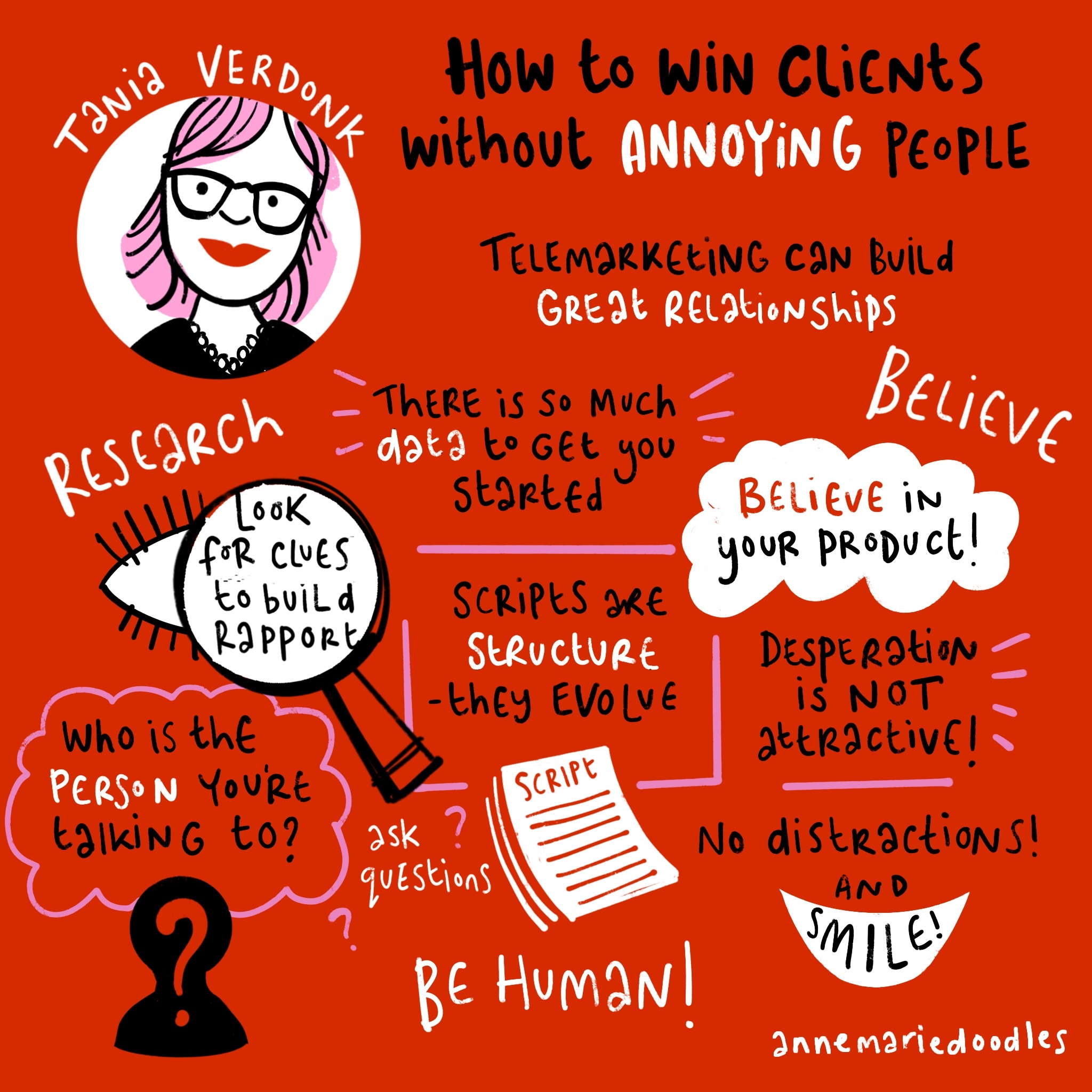
Do your research – get curious.
Time spent making sure the people on your list REALLY have a need for your services is the key to making this work. If you don't have a list it's possible to buy one that matches your target market but make sure it is GDPR compliant and that people haven't been added to a list without their permission - we all know how annoying that is.
Get clear about what you’re going to say.
Writing a script can be a comfort but it should be used as a guide, not a rote, and should evolve as you use it.
Here's an example
"Good morning / afternoon is it possible to speak to ....................?"
(Note: Gatekeepers are human – BE POLITE, BE SPECIFIC and sound as though you’ve done your research!)
"This is (your name) from (your company name) in LOCATION. (This let’s them know you’re a real human being not a call centre.) Have you heard of us before?" (This sentence builds rapport.)
"Okay, well as you may be aware we help businesses like yourself to PAIN POINT 1 and PAIN POINT 2 by providing YOUR CORE SERVICE. Example: We help businesses like yours have complete peace of mind and spend a lot less time on bookkeeping by providing an efficient and affordable accountancy service that helps you be more profitable."
BIG NOTE:
If you don't know the pain points / needs of your target market and the problem you're solving, take some time to test this out with people who know your business.
Questions for flow
- What do you currently have in place?
- How can we work together?
- When would you be reviewing your current contract / supplier?
- What don’t you like about your current system / provider?
- When would you like to see a demonstration of the system?
- I would love to meet you and see what you currently have and explore how we might be able to work together.
- Would you be available on date & time or date & time ? - *choose a morning appointment and an afternoon appointment*
*If they're not interested, try and establish why*
- I understand that you might not be interested at the moment but would it be possible to perhaps send you some information in case things change in the future?
Here is another script to catch up with lapsed clients / enquiries.
Be prepared:
Have their details to hand (including previous proposal, contact details and any other details of your contact at the time that you can glean from CRM / Notes etc) – This will make the call warm.
Pen and paper
SMILE – very very important – that is why I have a mirror, to remind me.
SCRIPT
"Hi can I speak to ...
My name is Tania Verdonk and I’m calling from Spirus Marketing in Burwell, near Cambridge. We did a proposal for you in September for a telemarketing campaign. Can you recall this? Do you remember?"
It doesn’t really matter what they say, just move on to next part.
"Okay, well, we provide marketing, business development and PR services and I just wanted to catch up with you since our last conversation and hear how you are getting on."
You can stay quiet at this point and see if they volunteer info.
Questions for flow of conversation
(open questions to let them speak)
- What did you decide to do after you got our proposal
- What services do you currently outsource?
- Do you have anything coming up for which you might need additional support?
- How can we be considered?
- Who did you choose to go with in the end?
- Can I send you some information regarding our services?
- We have a special offer / course starting. May I tell you abut it?
The golden rules of telemarketing
1) Necessities on desk
2) Close all unnecessary computer tabs
3) Chain yourself to your desk
4) Don’t put the phone down between calls, leave no longer than 60 seconds between your calls
5) DO NOT DISTURB ON YOUR OFFICE DOOR
6) Mirror to remind you to SMILE.
7) Do what you said you were going to do... Trust the process!
Note from Ann Hawkins: Don't set yourself the goal of making a set number of sales - that's not in your control.
Do set yourself the goal of having a set number of conversations. A call without a conversation doesn't count!
If you have any questions about this process, do get in touch!

Marketing without social media
If you couldn't use social media to market your business what would you do instead?
Drive Founder Ann Hawkins has been using social networks since 2008 and writes regularly about the changes we need to be aware of as both business owners and citizens.
More and more small business are realising the dangers of investing so much in platforms they can't control and are also keen to be less captive to their smart phones.
The scandals and uncertainty surrounding Twitter, Facebook/Meta, Instagram, TikTok, etc., may be the trigger for some people to think about this but lots of small businesses are spending HUGE amounts of time creating content that has little or no effect on sales, while they become slaves to their phones and get drawn into soul sapping habits like constantly scrolling, wasting time they'd be better off using for other things.
How else can you get noticed?
First figure out how many sales you need - how many clients or customers. For many small businesses this isn't thousands or even hundreds. Its a handful. So competing for attention on a platform where there are billions of users (many of them political, fake or run by bot farms) makes no sense at all. Choose the method that best fits your needs.
Quick Solutions
Some quick answers to the "what else can you do?" question: (more details and links below)
- Use more direct marketing: build an email list and email offers, news etc.
- Get found more easily by people who are searching for what you sell. Note that AI has had a huge impact on search activities and SEO is very different because of this.
- Use blogging to keep your website relevant and up to date and give you interesting content to share with your subscribers.
- Ask for Google reviews.
- Get recommendations / testimonials and copy them to your website, use them in content, both print and digital.
- Explore print: flyers, brochures, news outlets, magazines, interviews, PR articles.
- Sponsor events.
- Give talks, be a guest on podcasts. Find suitable podcasts at https://podmatch.com/ or https://www.matchmaker.fm/
- Go to trade shows, exhibitions etc.
- Phone people - not just sales calls but catching up calls, building relationships.
- Tele sales - works really if done by the right person who enjoys it!
The longer story
The problems with social media is not a passing phase. It's getting worse, with more automation, more AI, more content being driven by controversy and more influencers being paid to market brands. More people are choosing to avoid it altogether so finding other ways to market your business is essential.
LinkedIn isn’t perfect but its the least risky option for B2B marketing right now. (See How to Use LinkedIn for B2B Marketing)
You don't own anything on a social media platform
Most platforms state in their T's & C's (that few of us read) that everything you post becomes the property of the platform to be re-used or removed as they see fit, and increasingly, your content is being used to train AI apps. Your carefully curated contacts, articles, posts, videos, photographs and everything else could all disappear without notice or re-appear in someone else's content because it's being used by AI. There is usually no appeal.
When Facebook and Instagram last went off line for hours many small business say they missed out on hundreds of pounds worth of sales but had no recourse to compensation.
The very, very least you can do to minimise any adverse impact is to keep copies of all your important content somewhere that you control.
Invite people to stay in touch
Keep a list of all your important contacts - especially customers and enquiries - in a notebook, a spreadsheet or CRM. If you have an email address and /or phone number add those too. Anything else, like birthdays, the anniversary of becoming a customer etc., is gold dust.
Set up an email newsletter and invite people to sign up to it (they should always be able to unsubscribe when they choose). Use the newsletter for sharing interesting, useful or entertaining content as well as for direct marketing, special offers, new products or services.
Use your website as a powerful asset
Your website is like your online shopfront. You control and own everything that goes in there and can change it whenever you like. One of the most important things it can do for you is help you collect the details of your contacts.
A website is your property. You should own the domain name and hosting package - don't leave it with a website developer or host or anyone else. Keep it up to date and working for you.
For help and information with websites, get in touch with us for recommendations. See Everything You Need To Know About Websites by Susie Tobias.
Create great content
If all of your on-line activity was geared towards bringing people to your website it would all be much more powerful.
You can keep people on your site and happy to share their details with all sorts of engaging content that you own. Blog posts, reports, case studies, videos, workshops, etc are all great.
For maximum impact your content should be interesting, useful and /or entertaining. Just like on social media sites but now it's on YOUR site.
Word of Mouth
Word of Mouth is, always has been and always will be, the most effective marketing tool. It requires you to be good at what you do, honest, trustworthy, good at networking, building relationships and generous to the people you know by actively connecting them to others - and by others doing the same for you. This works really well for members of Drive, the Collaborative Network, where we concentrate on building trust.
TeleSales
Not many people in small businesses like making sales calls but telesales can be extremely effective when done done by someone who is not only highly trained and experienced but really enjoys the process.
Tania Verdonk at Spirus Marketing is just such a person and is highly recommended by many of our members.
I hope that's enough to get you thinking about doing less marketing on social media and more that's in your control. T
For more help on this please get in touch - our network has many talented people who combine their skills, experience, and expertise to help each other and come up with effective ideas and solutions.
Everything you need to know about websites
Do you want a website, have a website that needs updating, hate your website or have questions about how to keep your website up to date and secure?
Susie Tobias aka Wise Genius has been designing and building websites since 2010, helping new businesses get started and established business stay relevant and up to date.
The process of creating a website for your business can be daunting, and every business is unique, with its own set of challenges.
Susie brilliantly explained the basic site set-up, where to start with planning & strategy, important things to consider, how to keep things secure and up to date and how to check that your site is performing as it should.
Your website is the on-line home for your business

Imagine building a website is like building a house:
The land is the hosting and platform you build it on
The address is your domain name*
The post box is your email address*
* YOU need to OWN these.
The foundations are your strategy, who you are and what you do
The floor plan is the pages and how they're arranged
The decoration is the images, colours, fonts, etc.
The furniture is the content
Step One - Define a goal
What do you need the website to do for you?
- Act as an on-line brochure?
- Drive sales?
- Collect data?
- Prompt enquiries?
- Act as a shop or just a shop window?
Step Two - Define who the site is for
- Who is your ideal client?
- Why do they need you?
- What do you want them do when they find you?
Step Three - Decide who will supply the decoration and furniture
- Research competitors and role models to get inspiration and ideas (not to copy)
- A graphic designer will help create the look that most appeals to your potential clients (not to you or your friends) and along with the developer should be able to advise on accessibility issues. They can also advise on using great images, copyright etc., rather than using tired stock photos.
- A content or copywriter will write copy that appeals to your ideal client which is hard to do for yourself and causes most delays in website builds. They will also be able to advise on incorporating keywords for SEO.
Step Four - Decide on your website developer
- Always talk to more than one developer to get the best fit
- Research the difference between platforms, e.g. Wordpress and Squarespace and understand the limitations of sites like Wix and Weebly
- Look at the portfolios of the sites that your short list of developers has created
- Check credentials and testimonials
- When you have a discovery call to see if you're a good fit you should do most of the talking and they should be listening and taking notes, not selling you their solution
- Make sure you'll own the finished site and all the content and can switch developers easily if needed
- Check that you can make small changes yourself
- Choose a developer who involves you in the process, encourages you to ask questions and listens to your feedback
Step Five - Understand the ongoing maintenance process
- A website is never finished and done, it needs regular checks to make sure everything works as it should
- Either you or your developer needs to do regular back-ups, security checks, broken link checks and test forms and buttons to make sure they work properly.
Later ...
- Use Google Analytics to check how people use your site, which pages they visit, how long they stay, the bounce rate, where traffic comes from and the behaviour flow.
- Use this information to improve and update as necessary
 For more information and regular tips about how great websites work follow Susie on LinkedIn or get in touch at Wise Genius
More resources
- A question about how domain names are controlled led us down a rabbit hole - this is how it works:
Domain Tools Know How - An appraisal of different platforms: What should I use to build a website
- Tools to check accessibility: WAVE Web Accessibility Evaluation Tool
W3C's easy web accessibility checks
A11Y Project checklist
Why our network is like a jazz band
Have you ever wondered why some people prefer one kind of music to another?
Apparently there have been lots of studies on the subject - all of them inconclusive.
I like jazz. I don't know why. It just connects with me in a way that no other music does, so I was interested to read recently that more than 450 well-known jazz solos have been studied by physicists from the Max Planck Institute for Dynamics and Self-Organization together with psychologists from the University of Göttingen and they have unraveled the secret of what makes jazz different to other forms of music.
They were able to demonstrate that jazz musicians use certain systematic deviations in timing that gives the jazz its unique rhythm - but that they use them unconsciously. Co-incidentally, many years ago, Charlie Watts (first and foremost, a jazz musician) was surprised to discover that this is what created the unique sound of the Rolling Stones.

If you've ever seen a jazz band play you'll have noticed that they don't need a conductor, rarely use sheet music and rely on a great deal of improvisation. They really listen to each other and move in and out of playing a lead role and then make way for others players without any direction.
So here's my segue ...

I'm often asked what makes this business community, Drive the Collaborative Network, so special. I didn't design it to be the way it is. It's become a unique and very special network because of the people who are in it and they way they respond to each other.
Our members have a lot in common with a jazz band:
* Everyone is talented
* Everyone respects each other's talent
* Many people are talented in the same area but they all bring different qualities to their work
* Everyone is more than their work: their character and values influence everything they do and how they interact
* Members never try to grandstand or sell themselves, they turn up to contribute
* They play off each other's strengths
It's a subtle and unconscious way of creating a great feeling with no egos involved.
It's taken me a long time to figure it out but now when some asks "What makes the Drive community so special?", I'll tell them maybe scientists could work it out but for us, its just like jazz - we do it without thinking about it!
If this style of collaborative networking appeals to you, come and try us out, see if we're a fit for how you like to work and explore what we can do together.
How to have conversations about climate change
Climate change conversations can be a bit challenging
Overview: These techniques are useful for any conversation that might feel difficult or awkward:
- Have a conversation about having the conversation, don't just launch straight in.
- Figure out what's getting in the way: anxiety, guilt, shame all stop people from talking.
- Think of everything you know about the topic and don't mention any of them.
- Listen more than you talk.
- Evangelising doesn't work.
- Ask how people would like to take it forward to keep talking.
Jo Twiselton is an organisational change consultant and coach.
She is a certified Carbon Literacy coach and has had many conversations about climate change and how it affects our personal wellbeing as well as how it is handled in organisations.
Many people avoid talking about climate change or get into heated discussions because the subject is so emotive. Jo gave us some great tips about how to have these important conversations with colleagues, friends, family, employees, employers and more.
Is anybody bothered?
Because many people avoid getting into these conversations it would be easy to believe that they're not bothered so its worth noting that in October 2021, 75% of adults in Great Britain said they were either very or somewhat worried about the impact of climate change. Survey by the Office of National Statistics
Jo started by exploring what stops people from having these conversations.
What comes to mind when you're having a conversation about climate change?
Responses to this included:
Anxiety, frustration, where to start, apathy, innovation, defensiveness, fear, anger, its hard to see the impact of what we do, money, fear of change and fear of not changing.
Conversations don't have to be about the science
Weighing straight in with information on the methane emissions of cows and the carbon footprint of a banana won't stop people from eating either. Jo says that Charly Cox, Climate Change Coach changed the way she approaches these conversation by explaining "Climate change is a human behaviour problem." If the conversation is about what moves things forward it's more likely to bring about change. Helping people to understand that they don't have to be perfect and give up everything they like but that its enough to do something is the best way to start.
Avoid preaching and trying to persuade people
Confronting a group of friends about their plans to take a short haul flight will only damage the friendship and make them avoid you. You can't change people who aren't ready so start with the people who are willing to meet you half-way and with things that are close to their hearts until you get more confident about having these conversations. Discussing a local project, something that feels closer to them, is more likely to get people's attention than talking about melting glaciers and depleting rain forests.
What are we trying to avoid when we don't have these conversations?
This is how people responded:
Defensiveness, conflict, switching people off, upsetting people, shutting off the opportunity before it gets going, worried about how we're perceived by others (not being seen as a geeky weirdo), withdrawal, virtue signalling, committing to something we can't deliver.
How to have different types of informal conversations
- Dive straight in: People who have a common interest in the topic and are comfortable chatting about it. Share information and ideas.
- Go easy: People who are slightly engaged, who may be exploring, looking for ideas and answers but don't want to to be preached to. Climate Scientist Katherine Hayhoe says, "If I'm going to have a conversation with someone, I first find out what we have in common."
- Move gently: People you're not sure about, you don't know where they stand. Ask questions, listen, meet them where they're at. Don't judge. Some people are just getting by and don't need anything else to worry about.
- Don't wade in: When a family member of colleague installs a plastic lawn or otherwise signals that they're not up to thinking about the effects of their actions on the planet and you need to maintain a relationship with them, wait until they give a signal or the opportunity arises, indicating that they may be open to a discussion. Offer information only if you're asked or it feels right. Find out what's important to them or what could be a conversation-starter - how to save money on energy and how that can help this wider topic is a great place to start.
Conversations in groups or training situations
Prepare: People need to know what they're being asked to take part in and given enough information to help them avoid feeling uncomfortable, guilty, ashamed etc.
Space: Physical and emotional space are equally important and will help people move to new perspectives.
Don't lecture or grandstand: You may be the expert in the room but think of everything you know about the topic and don't say it. Offer information only if you're asked.
Ask Questions: Be genuinely interested in other people's perceptions and positions. Find our where they're at without creating comparisons, league tables etc. Avoid making anyone feel awkward or left out.
Share stories: Stories connect us, tell people how you got interested or tell stories about other people who are taking action they can relate to.
Allow people time to get on board: Creating change, especially changing hearts and minds takes time. Let people come at it at their own pace and give them opportunities to learn more as they need it.
Audience contributions
- Talking on social media is generally much more difficult than having a conversation face to face or even on Zoom so its best not to get involved but invite anyone who is interested to a different way to take things forward.
- As a consumer be really nosey about the products, institutions and processes you use. Many try to disguise their true credentials - or lack of. The Ethical Consumer is a good place to start.
- If people are already defensive and talking about what they're "not allowed" to do, it can be disarming to say of course they're allowed to do whatever they choose, but they do have a choice so what would the consequences be of doing something different?
- Share positive achievable and relatable examples of what has been and can be achieved.
- Know your audience. Language is really important. Climate change can be seen as a middle class issue so combating stereotypes is a good idea.
- If you suspect someone is just out for an argument try calling them out on it, "Are you genuinely interested in my views on this?" can save a lot of grief.
Finally - the three Ps
Before you leave and get on with your day take a pen and paper and write down three things you'll do as a result of reading this post. Consider actions in these three areas:
- Your Personal Life
- Your Professional Life
- Your Political Life
How would you like to take this conversation forward?
If you'd like to keep talking about this topic, find out more about Jo's work at Twist Consultants and follow Jo on LinkedIn to let her know you're interested!

Useful resources:
- Climate change coaching – Charly Cox and Sarah Flynn
https://climatechangecoaches.com/our-book/ - Katherine Hayhoe – climate scientist – she does some great work in translating science to conversations
http://www.katharinehayhoe.com/ - Active Hope – how to face the mess we’re in without going crazy
Joanna Macy and Chris Johnston
https://www.activehope.info/ - Ten ways to confront the climate crisis without losing hope
https://www.theguardian.com/environment/2021/nov/18/ten-ways-confront-climate-crisis-without-losing-hope-rebecca-solnit-reconstruction-after-covid - For solid background facts
How bad are bananas - Mike Berners-Lee
The Carbon Almanac – Seth Godin and loads of other contributors!
World Wide Waste – Gerry McGovern (recommended by Berenice Howard-Smith) - Jo's personal favourites that support conversations
Losing Eden – Lucy Jones – a review from Jo: https://www.twistconsultants.co.uk/blog/book-review-losing-eden?rq=Lucy%20Jones
From What is, to What if by Rob Hopkins - a review from Jo:
https://www.twistconsultants.co.uk/blog/book-review-from-what-is-to-what-if-rob-hopkins?rq=imagine
A free climate impact calculator that lets you and/or your business as a whole calculate the carbon footprint of your vehicles, properties and any form of travel: https://miabazo.com/climate-impact-tool
Negotiation skills
How to negotiate better deals
Negotiation is an essential business skill, useful in many situations with clients, suppliers, employees and associates.
This discussion on how to improve our negotiation skills was led by Tom Lewis FCA.
Tom is a Commercial Performance Improvement advisor to businesses who helps businesses grow strategically through both organic and acquisitive change and has held positions as Commercial CFO / COO in Private Equity SaaS, B2B Consultancy Services, Marketing Services and Law.
Pricing, self-worth and self-confidence
Talking about negotiating skills in small businesses almost inevitably leads to questions about business structure and pricing which are directly affected by our feelings related to money, self-worth and self-confidence.
Self-confidence is a key element in success and there are many ways to improve it so if this is a factor that is holding you back its worth working on!
Before you start negotiating ...
Before getting into any negotiation it’s a good idea to figure out how important it is to get your own needs met v. how important it is to maintain a good relationship with the other side.
- What do you need?
- What does the other side need?
- What concessions are you prepared to make?
There are five key styles of negotiation
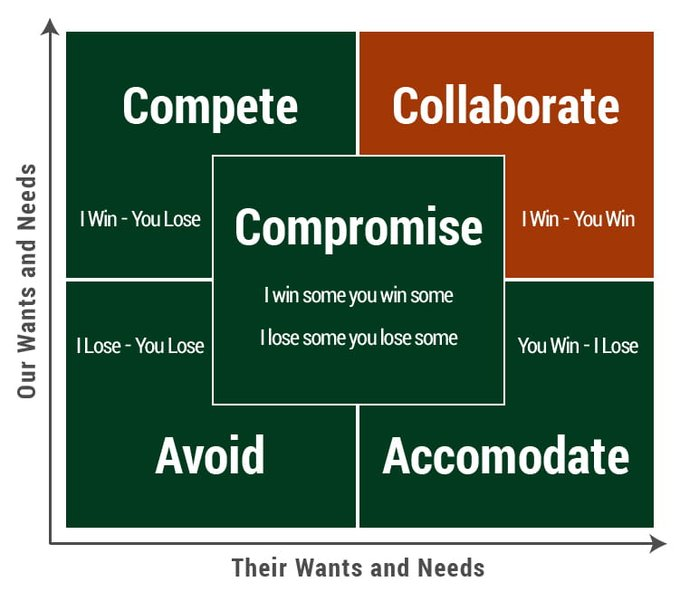
Familiarise yourself with these different styles and try to figure out what style the other side will use and how you will respond.
Do you hate hagglers?
Haggling isn’t really about negotiation and is often a sign of inexperience. It’s taking an extreme stance with the mindset of win some, lose some. People who haggle throw lots pf demands into the mix. They’re usually shameless but probably have the aim of getting you to meet them halfway - which may not be obvious at the start.
If you go into this situation expecting someone to play fair it may come as a shock and throw you off balance but having a very clear idea of what you want can often turn it around.
Compromising
Compromising may mean that you’ve got the main deal so are comfortable compromising on the peripherals. For example someone has agreed to your fees, but they may ask you to compromise on the payment terms. It's important to know before you start what your points of compromise will be.
- What are the things you can’t move on?
- What’s the scope for negotiating?
- Is trust an issue?
Win : Win
You may think this is always the best outcome for everyone but there will be people who prefer to win by forcing you to lose – usually when there is no ongoing relationship to protect. If you come across this you must be very sure of what will make you walk away.
What’s your red line position?
You may be really busy and not need any more work but someone asks you to squeeze in an extra project. Your red line may be that you'll only do this if they're prepared to pay extra to make it worth your while or there’s no deal.
Win : Lose
This position is usually associated with a transaction like buying a house or car. There is no on-going relationship to protect so going all in for what you want and asking for concessions when the main deal is done is fine, depending on how much you want the item. Again, knowing your red line will help you walk away if you can't get what you need.
Negotiating on price
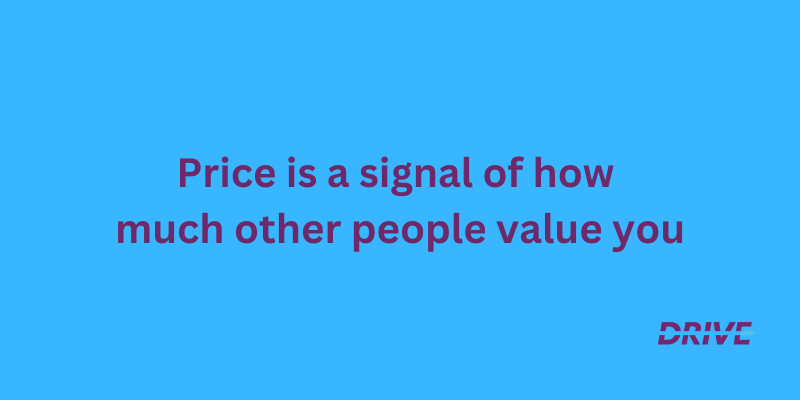
We’ve all had conversations where a potential client says they really want to work with us but they just can’t afford our fees.
In this case your killer question might be: “What can I do to show you the value of what I’m offering? If, as a result of working with me your business increases by x amount, what would that be worth?”
The answer will almost certainly be a lot more than your fee so the negotiation is about persuading the client to see you as an investment rather than a cost.
Discounting
Have a discount policy carefully worked out before going into any negotiation. Do the maths and make sure you’re not eroding your profit margins.
Your time is not free. If one of your marketing tactics is to have “free” consultations before a client signs, this should be factored into your marketing costs and measured against results.
Friction is a lead qualifier
People who don't like negotiating or want a less time intensive strategy often package services or deals to make choices easier. This can be designed to reduce friction but it's worth noting that there must be some friction to get an active choice and commitment from a client. The reason so many free offers don’t work is that there is no friction therefore no commitment.
After action report
As with all business activities it’s a good idea to take time to review what worked and what didn’t. The key question here is “Did I leave money on the table?”
Other questions are:
- How do you feel about the process and the result? In our discussions a very strong preference emerged for doing business in a way that aligns with our values, so winning comes second to how we feel about winning and how we handled the process.
- Is the process getting easier? If you're improving your competence and confidence and feeling more comfortable about negotiating that's great. If it continues to be a problem it would be worth going back to looking at the issues of self-worth and self-confidence and getting help to work on those.
- Is your pricing strategy and business process enabling you to make the most of opportunities or do they need to be reviewed?
As always, get in touch to discuss any of the issues raised here and if you'd like to explore the topic further we'll invite Tom back for another session.
Tom Lewis
Tom has led merger and acquisition deals for plcs and owner-managed SMEs, cost-effective market exits and successful business mergers / integration, is experienced in leadership and influencing decision-makers at board level through both analysis and negotiation, increasing commerciality, coaching staff to improving pricing, volumes and productivity, cash flow management, cost reductions and strategic restructurings, and refining finance systems and management information for swifter, better decision-making.
Tom holds a BA in Russian Studies and spent a year in Russia and Ukraine and is a keen amateur wine blogger.
Connect with Tom on LinkedIn and Twitter
Six tips for getting organised
Do you regularly run out of time or wonder where the hours have gone?
Andy Boothman has been running his design and branding business Busy as AB for over 25 years. He has managed many hundreds of clients, teams of freelancers and in-house teams all while enjoying a busy family life, enjoying live music gigs, outdoor pursuits and, four years ago, launching DressCode Shirts, a business that required him to learn many new skills and manage production schedules, ethical manufacturing processes, wearable tech, e-commerce and much more.
To keep all these balls in the air, deliver great work and still enjoy life requires great organisational skills so we asked Andy to share his top tips for getting organised.
During the Q&A we quoted Douglas Adams:
“I love deadlines. I love the whooshing noise they make as they go by.”
This was misheard by Anne-Marie Miller and resulted in this doodle which has been added to the many works she has produced to illustrate things said at our meetings!

Here are Andy's tips:
- Play to your strengths, don't try to do everything yourself and outsource as much as possible of things that are routine or boring.
- Speed is important but don't set unrealistic deadlines. Often we put pressure on ourselves when it doesn't matter to the client. As you get better at something you may get faster but that doesn't mean you should charge less. The value to the client is what's important.
- Tracking systems help in lots of ways: check actual time v estimated time, check billing. check who does what and who gets paid what, check time spent waiting for clients to do things.
- Doing work on paper can be simpler and easier than using digital tools, especially if the digital tools are shared with a team.
- Planning:
i) use Friday afternoons to plan for the following week while work is fresh in your head, Checking what work has been done gives you a sense of achievement and clears your head for the weekend. Starting fresh every Monday with a plan already made is a big advantage.
ii) plan each meeting and leave time between meetings to review, reflect and prepare for the next one. NEVER jump from one meeting to another without a break, you won't be focused and everything will take longer.
iii) plan your own business development every week or you'll miss opportunities. - Set firm boundaries and manage clients expectations. Have clear working hours and channels of communication. Do not answer queries outside of these. One demanding client can ruin your relationship with others and clients know when they're being bumped because someone else is shouting louder so make sure you treat everybody, including yourself and your family, fairly.
- Recognise when you're not being productive and don't flog a dead horse. Stop and do something different, take a walk, go for a run, play a game, read, doodle, bake, anything that takes your mind of the work. When you come back to it you'll be much more productive.
- Protect your personal time. We all work for ourselves because it gives us more freedom to do the things we really love so build these things into your schedule and stick to them. They're the most important of all.
Connect with Andy on LinkedIn


How to use social media, especially LinkedIn, for B2B marketing
Are you trying to figure out what to do with all the social media advice that gets thrown around?
Dan Ince of BrandWorks Social is in the Ask the Expert chair.
Dan uses his many years experience in marketing consultancy with big name brands to give small businesses access to a more strategic approach to social media. He recently did a
Focusing on small service businesses who mainly use LinkedIn, his advice helps us identify the best strategic approach based on what we want to achieve.
Here's what Dan recommends:
Get some clarity
Before diving in and potentially getting overwhelmed, be clear about why you’re using a particular social media platform for your business.
For a small B2B service, it's best to use your activity to create brand awareness and showcase your skills and knowledge rather than try to fill a sales funnel and find leads. Treat it as a long game in building strategic* relationships.
*Strategic means people who may become clients or recommend you - not your peer group or friendship group.
Be really, really, really clear about who you want to reach (potential clients), what their needs are and how you can help them. Write posts with the intention of being useful and engaging for that audience.
Remember that your social media footprint – the things your audience sees – includes your likes and comments on other people’s posts so make sure you don’t slip into becoming irrelevant to your audience by liking posts that will make them unfollow you. (That sympathy like / emoji for your friend with a bad back is best handled in a private message).
Take it slowly and discover a need before you try to sell. If someone doesn’t need what you do, trying to sell to them is a waste of time and will just annoy them.
Be consistent
The tagline “Mr Kipling makes exceedingly good cakes” is 60 years old.
“I'm lovin' it” was first heard on a McDonalds ad in 2003
“Every little helps” has been used by Tesco since 1993
“Creating a buzz for your business” has been Andy Boothman’s tag line for Busy as AB for over 25 years.You may not have a memorable tag line but you can create consistency by being clear on your values, key messages and in the way your posts look as well as their style and tone.
*Ring the bell on LI profiles of people you follow to get notified about posts as they're published.
Don't worry too much if people don't appear to be "engaging" with your posts. 90% of people on LinkedIn never engage with anything but this doesn't mean they're not reading your content. Lots of enquiries come from people you may never have been aware of until they contact you. This is why being consistent matters.
Ensure your LinkedIn profile is up to date and relevant to your audience – if people like your content, they’ll take a look at your profile next. Your tone of voice should reflect who you really are. If someone who has been reading your posts has a call or a meeting with you they shouldn’t discover that your posts give a different impression to you in person.
Don’t get sucked into trends that don’t suit your style or purpose. Selfies are not always a good idea, especially just because everyone else is doing them. In fact, if your content looks and feels the same as everyone else, you won’t stand out.
Advice on "being personal"
This is the most misunderstood advice on social media. If you're using a platform as part of your marketing strategy to connect with potential clients think carefully about the impression you're giving them. While most people are nosey and people buy from people, sharing personal content is a fine balance between helping you look interesting (hobbies, activities, interests etc.,) and a big red flag to potential clients who may see inconsistency as a liability. If you wouldn’t walk into a meeting with a new client and start the conversation by saying “I’m having a shit day” its probably not a good idea to share that on social media. Also be mindful of the impact your ‘too personal’’ posts may have on other people who are just trying to get through another day in business.
How often to show up
It’s worth remembering that 95% of your target audience aren’t ready to buy what you have to offer at any given time, hence the need to be active on social media frequently but it’s always better to post when you have something interesting to say than scrape something together that’s pretty flimsy just because you’ve been told “it’s good to post three times a week”.
No-one will notice if you don’t post but they will notice if you post drivel!
The best time to post is whenever works for you. There are no rules. Some people get a good response if they post at weekends or in the evening and others stick to Mon-Fri, 9-5.
To get results from social, it’s vital to not only share great content, but also engage with your audience. If someone comments on one of your posts always reply and try to say something more interesting than "thank you". It’s called ‘social’ media for a reason!
Set aside regular time to curate and engage with your network.
Most of all be human, be you and remember, if you look & feel the same as everyone else you’re just average!
===================
This is a big topic and how we each handle social media will vary a lot, depending on what we’re trying to achieve. It can be very time consuming to figure out what works so to find out what’s best for you and your business we recommend contacting Dan who has lots and lots of useful strategies to ensure you get the right results.
 Dan Ince
Brand Works Social
07770 738323
Is staying small the next big thing?
Growth is often seen as a measure of success in business but it's not what everyone wants
When you're booked to capacity and your earnings are limited by how many hours you can work, and you don't want to employ other people or outsource, what's the next step for your business?
This is the question many small businesses, freelancers and consultants face. They're often urged to adopt tactics that move them away from doing what they love and into the realms of managing other people which is not everybody's idea of fun.
Bianca Botten was pondering similar questions about developing her busy VA business Neon B when she read the book Company of One by Paul Jarvis.
Jarvis is a veteran of the online tech world who realized that working in a high-pressure, high-profile world was not his idea of success. He now works for himself and no longer has to contend with an environment that constantly demands more productivity, more output and more growth.
Bianca wrote the following review of the book:
Company of One is a book about improving business and providing the best service to your current clients. It questions whether growth is right for you, or if having a business that fits around your lifestyle is better.
I found myself nodding along with the author for the first half of the book, agreeing that you should build long-term relationships with clients, (so they send you repeat business). Continuously searching for new customers is time consuming and costly whereas, “maintaining good business relationships with customers doesn’t require superhuman efforts. Rather, you simply need to do what you say you’ll do and customers will be grateful”.
I love the idea of becoming better at what you do by improving systems and processes to be more efficient in how you run your business. For me this feels like mastery and being the best version of myself.

The end of the book didn’t hold my attention and I found it a little repetitive. Throughout the book the author kept mentioning being a “Company of One” at an organisation, and I felt he was trying to appeal to people who work as contractors inside big businesses rather than microbusiness, freelancers and solopreneurs.
Company of One confirmed how I felt about my business and reinforced that I would prefer to provide a good service to a small group of loyal clients, as opposed to exponential growth, which would mean more noise and chaos.
I much prefer a business that fits around my lifestyle of raising children and being the best, least stressed version of myself.
I can recommend reading this book and give it 7 out of 10.
If you've read the book or find yourself asking the same questions as Bianca we'd love to hear from you - leave a comment below or get in touch at info@drivethenetwork.com
 Follow Bianca and Neon B on
LinkedIn
or
Instagram